
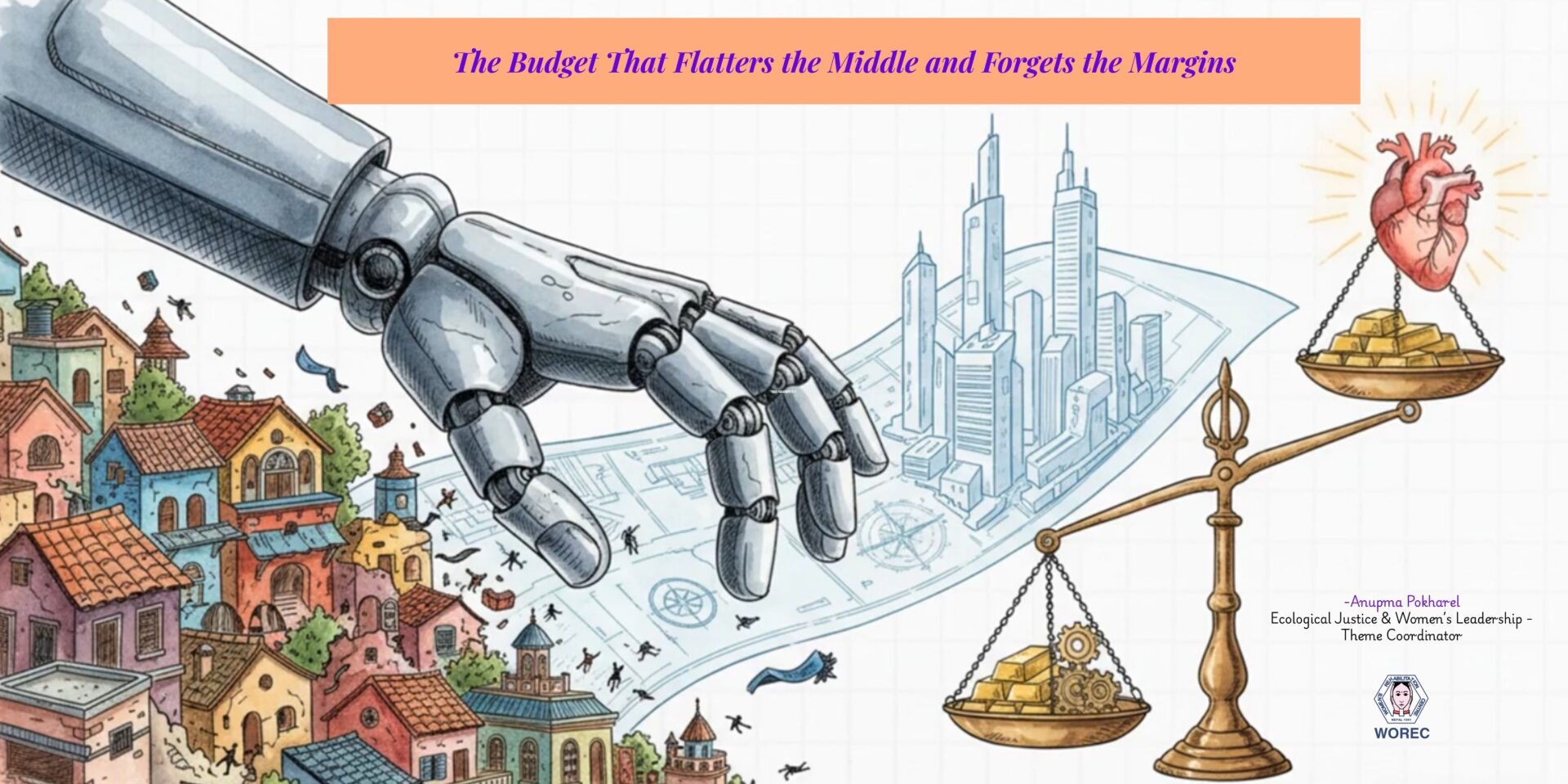
Nationalism, the Rise of the Middle Class, and What Nepal’s 2083/84 Budget Leaves Unsaid
No government in Nepal’s history or elsewhere has ever announced its arrival by declaring it intends to take something away. Every shift of power from the Panchayat era to the republican transitions of the past two decades has presented itself in the language of rescue: stability, development, national pride, and good governance. The pattern is consistent enough to be a rule. Which is why a budget, more than any speech or manifesto, is worth reading carefully. It cannot entirely hide what it is doing.
Nepal’s FY 2083/84 budget deserves this kind of reading, not because it is good or the worst budget in living memory, but because of what it quietly assembles beneath its reasonable surface. Taken as a list of line items, it looks like responsible governance. Taken as a political document, which every budget ultimately is, it raises questions that its authors would prefer not to be asked.
The Middle Class as Political Project
The most striking feature of the 2083/84 budget is not any single provision but the cumulative portrait they paint together. Personal income tax thresholds have been doubled. Upper-bracket tax rates have been softened. Civil servants, teachers, the army, and the police have received notable salary increases. Regulatory and tax concessions have been extended to the business community. Each of these decisions is, in isolation, defensible. Together, they describe a state that has identified its constituency and is rewarding it.
That constituency is the Nepali middle class. And historically, not just in Nepal but across the modern political world, this is precisely the class that ambitious governments court first. It is salaried, educated, organized enough to vote reliably, and anxious enough about its position to be grateful for protection. In the 1920s and 1930s, European political theorists observed with concern that the middle class was the most easily mobilized social force, not by promises of radical change, but by promises of stability and recognition. The class that has something to lose is the class most responsive to a state that promises to protect what it has.
A prosperous middle class is, in the abstract, a democratic good. But when it becomes the exclusive horizon of state concern, when the political economy reorganizes itself around its comfort, the outcome is not a stronger democracy. It is a narrower one. The feminist economists Diane Elson and Isabella Bakker spent decades making a deceptively simple argument: budgets are not neutral instruments. They always make choices about whose economic reproduction the state considers worth supporting. The question this budget invites is who, exactly, is being left to manage on their own.
Consider the arithmetic. When salary increases push up purchasing power in Kathmandu, rents rise, food prices creep upward, and the cost of services follows. The salaried worker absorbs this because their income went up. The woman selling produce in Asan market, the construction worker earning six hundred rupees a day with no contract and no union, the domestic worker in Lalitpur whose labour never appears in any economic accounting—their incomes did not go up. The distributional effects of fiscal decisions ripple in directions that budget speeches rarely follow.
The Land No One Speaks Of
Of all the silences in this budget, none is louder than its silence on land. There are provisions for farmers’ subsidies, irrigation allocations, and rural road budgets. What there is almost nothing for is the landless: the hundreds of thousands of families, disproportionately Dalit, indigenous, and women-headed, who farm land they do not own, live in settlements the state classifies as informal, and have in recent years faced forced evictions as urban expansion and infrastructure projects claimed territory they had occupied for decades.
The scholar Bina Agarwal spent years documenting what happens when women lack secure land rights across South Asia, and her conclusions remain uncomfortable reading for any government that considers itself progressive. Land is not simply about farming. It is collateral for credit, security in old age, and the single most important determinant of a woman’s ability to negotiate- in her household, in her community, and in her dealings with the state. Remove land security, and every other policy intervention becomes structurally weaker. Agricultural subsidies do not reach those who cannot prove they own what they are farming. A microcredit program cannot build durable assets without land as collateral. Social protection schemes require an address.
The budget’s silence on this is not a neutral omission. It coincides with a period in which evictions of exactly these communities have continued without a serious policy response. A state that allocates nothing to land security while simultaneously approving projects that displace the landless is not simply failing to address a problem. It is choosing a side.
Nationalism as Economic Theology
Read the budget speech carefully, and a particular vocabulary emerges: motherland, renaissance, self-reliance, sovereignty, strategic vision. These words appear so often that they begin to feel atmospheric rather than argumentative. That is precisely their function.
When economic policy is wrapped in the language of national destiny, it acquires a kind of immunity from ordinary scrutiny. A road becomes a symbol of national pride rather than a fiscal allocation with an opportunity cost. A project framed as part of Nepal’s great renaissance cannot simply be evaluated on its returns; to question it risks appearing to question the renaissance itself. This is not a Nepali invention. It is one of the oldest techniques in the political economy of nationalism, from Mussolini’s infrastructure projects to the “national development” rhetoric that has accompanied authoritarian consolidation across Asia in the past thirty years. The content differs. The technique is consistent.
The feminist theorist V. Spike Peterson has written extensively on what nationalist economic projects typically do to women: they cast women as the reproducers of the national future, mothers, culture-bearers, symbols of virtue, while deferring their economic claims indefinitely. National development always comes first; equality can wait until the country is stronger. Nepal’s budget does not explicitly invoke this logic. But its treatment of unpaid care work, which Nepal’s own Time Use Survey shows falls overwhelmingly on women and constitutes a substantial portion of all economic activity in the country, is instructive. It does not appear in the budget’s analysis, it does not inform its allocations, and it receives no structural recognition. The work that keeps every other sector functioning is, in official economic terms, invisible.
The Architecture of Efficiency
Running alongside the budget is a program of administrative reorganization: ministries consolidated, departments merged, decision-making streamlined. The government presents this as modernization, and there is genuine merit in reducing bureaucratic redundancy. Nepal’s administrative structures accumulated layers over decades of political transition, and not all of those layers serve useful purposes.
But there is a version of efficiency that functions primarily as concentration. When oversight bodies are merged, the number of institutions a citizen can approach to contest a decision quietly shrinks. When decision-making is centralized, the distance between policy and accountability grows. Democratic theory has long recognized that the apparent inefficiency of institutional pluralism, the overlapping jurisdictions, the redundant checks, and the slow deliberative processes, is not a design flaw. It is the architecture of accountability. It is how systems prevent capture.
The Gradual Arithmetic of Erosion
There is a temptation, when observing these patterns, to reach for the most alarming available framework. It is a temptation worth resisting. The 2083/84 budget is not a fascist document. To call it one would be not only inaccurate but counterproductive, a claim so large it forecloses the more precise conversation that the budget actually demands.
What is worth naming is something more incremental and therefore more difficult to see. The conditions that produce authoritarian capture rarely arrive as sudden ruptures. They accumulate through a series of individually reasonable steps: a tax cut explained by economic theory, a salary increase justified by years of compression, an administrative merger sold on efficiency grounds, a nationalist flourish that seems merely rhetorical in isolation. Hannah Arendt, tracing the origins of twentieth-century totalitarianism, was most disturbed not by the dramatic moments but by the ordinary ones: the normal-seeming decisions that, in retrospect, had been quietly preparing the ground for what followed.
Nepal is not at the end of any such process. But the structural question the 2083/84 budget invites is this: is the Nepali state, through its fiscal choices, becoming more responsive to its most vulnerable citizens, or more responsive to those already positioned to benefit from its resources? A salary increase for a civil servant is not a neutral event in a country where rural women perform the majority of economic labour without pay, without security, and without recognition in any official accounting.
Dozens of governments across the world have adopted gender-responsive budgeting as a formal methodology, including Nepal, in their own planning documents. The approach asks not merely how much is spent but where it goes: across gender, caste, geography, and class; which communities benefit from which line items; and whose unpaid labour subsidizes the sectors that appear most productive on paper. Measured against Nepal’s own stated commitments to this framework, the 2083/84 budget is notably quiet about the questions the framework would require it to answer.
A Global Trend Nepal Should Read Carefully
The combination this budget assembles, middle-class reward, nationalist vocabulary, administrative centralization, and the structural invisibility of its most marginalized citizens, is not unique to Nepal. It is a recognizable pattern in the contemporary global politics of populism.
From India to Hungary, from Turkey to the Philippines, governments across the political spectrum have discovered the electoral effectiveness of the same basic formula: make the aspirational class feel seen and protected, use nationalist sentiment to define the legitimate citizen and the national interest, and manage the remainder through a combination of rhetoric and selective enforcement. The pattern does not require malice. It often requires only the ordinary logic of political incentives: reward those who can reward you; the invisible cannot organize in return.
What history suggests, consistently, is that this formula is stable only until the people it excludes can no longer sustain the exclusion quietly. When the landless family that found nothing in the budget loses its home to a development project and protests outside the municipal office, it will not be met with a budget allocation. It will be met with a different kind of state response entirely. This is not a prediction about Nepal’s future. It is a description of what has happened, in variations, everywhere this pattern has run its course.
The Real Question
Nepal’s 2083/84 budget will almost certainly be remembered as a competent one. Growth projections will be cited. Salary increases will be appreciated. The professional class will feel, not unreasonably, that the government has paid attention to them.
The question worth asking—the question this piece has been circling, is what democracy looks like when it learns to satisfy those with the loudest voice while the rest wait. Not because waiting is always wrong. But because in Nepal, as in most places, the waiting has been very long already, and the people doing it are almost always the same people.
The domestic worker whose labour subsidises the professional household that just received a tax cut. The Dalit family in Siraha farming land they cannot legally own. The indigenous community in the hills watching a road arrive where their forest used to be, inaugurated with a ribbon-cutting and a speech about the nation’s bright future.
Freedom does not usually end with an announcement. It ends, where it ends, through a series of budgets. Through the slow arithmetic of who is seen and who is not. Through the quiet accumulation of decisions that each seemed reasonable at the time.