

Program: Campaign for Democracy, Women’s Rights and Youth Participation
Locations: Biratnagar (Koshi), Dhangadhi (Sudurpaschim), Butwal (Lumbini), Janakpur (Madhesh)
Background
Nepal’s socio-political history has been shaped by continuous movements and transitions, with youth playing a frontline role in major democratic milestones including the 1951 democratic movement, the 1990 People’s Movement, the 2006 People’s Movement, and the 2015 Constitution. Youth contributed significantly to political change through activism, awareness-raising, and promotion of democratic values. Young women participation—nearly 40% during the decade-long armed conflict—followed by the peoples movement including Madhesh movement led to constitutional guarantees of 33% women’s representation under the 2015 Constitution, which envisions a federal democratic republic governing system with inclusive and proportional governance.
Despite these commitments, meaningful youth participation in decision-making remains limited. While youth are active within political parties, their representation in leadership positions is low.
When feminist activists took to the streets demanding state and political party accountability, an end to impunity, and stronger democracy, Gen-Z youth across the country also mobilized in September 2025, calling for good governance, transparency, and freedom of expression. These movements contributed to an important political shift. As preparations begin for the House of Representatives election scheduled for 5 March 2026, youth across provinces express strong hopes for transformative change, a strengthened democracy, and inclusive leadership.
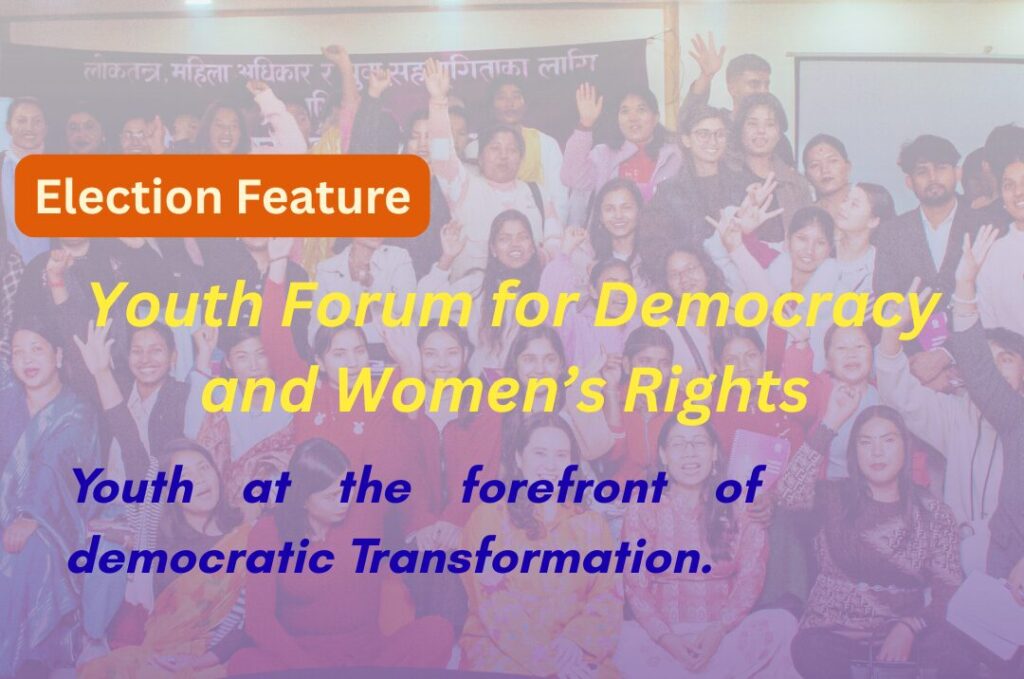
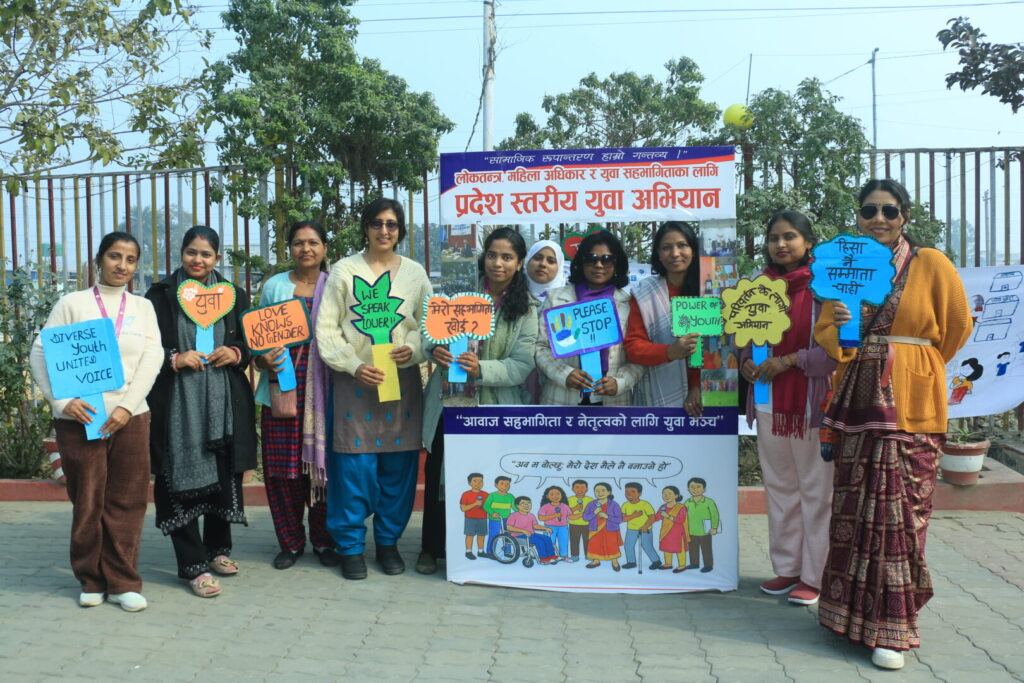
WOREC is a feminist organization working for democracy and social justice. Grounded in past and ongoing struggles, WOREC believes that without a strong and inclusive democracy, the rights of women and other marginalized communities cannot be protected. At a time when democratic values are being challenged in many ways, WOREC along with other likeminded organizations organized Provincial Youth Forums in four provinces to strengthen democratic practices and uplift diverse youth voices. These forums created inclusive spaces for more than 500 young people—especially women and marginalized groups—to reflect, speak out, and engage in discussions on leadership, democratic values, policymaking, and political participation. Through panel discussions, group work, and keynote reflections, the forums demonstrated collective learning and ended with Declaration Papers that were publicly shared through press conferences, reaffirming youth commitment to and demand for democracy and social justice.
Key Provincial Insights
Koshi (Biratnagar)
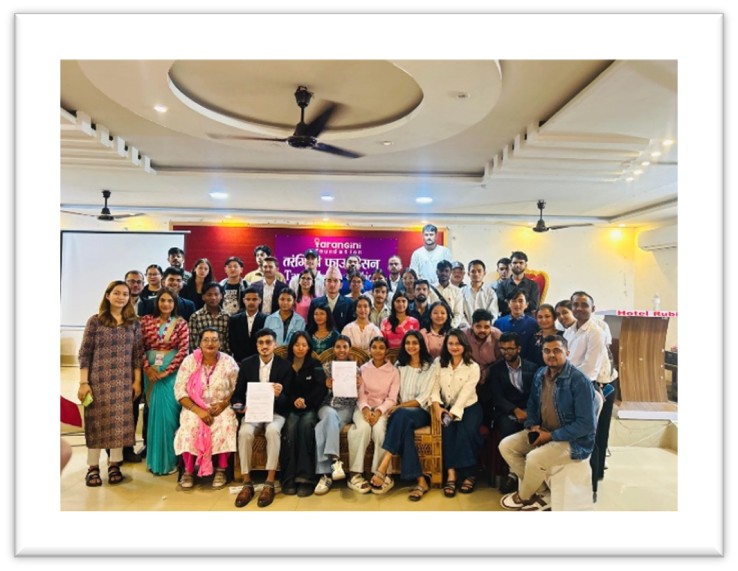
On 9 November 2025, a provincial-level youth gathering was held in Biratnagar, jointly organized by Tarangini Foundation and WOREC, with the participation of around 56 young people. Discussions during the gathering concluded that democracy can only be strengthened when the foundations of a democratic republic—such as the rule of law, good governance, transparency, inclusiveness, political freedom, and free and fair elections—are firmly upheld.
Youths from Koshi joint appeal , ““We, the youth, are responsible for strengthening democracy. The state must create an environment where questions can be raised, and it must be accountable. We are committed to building an educated and responsible society by fostering political awareness.”
Sudurpaschim (Dhangadhi):
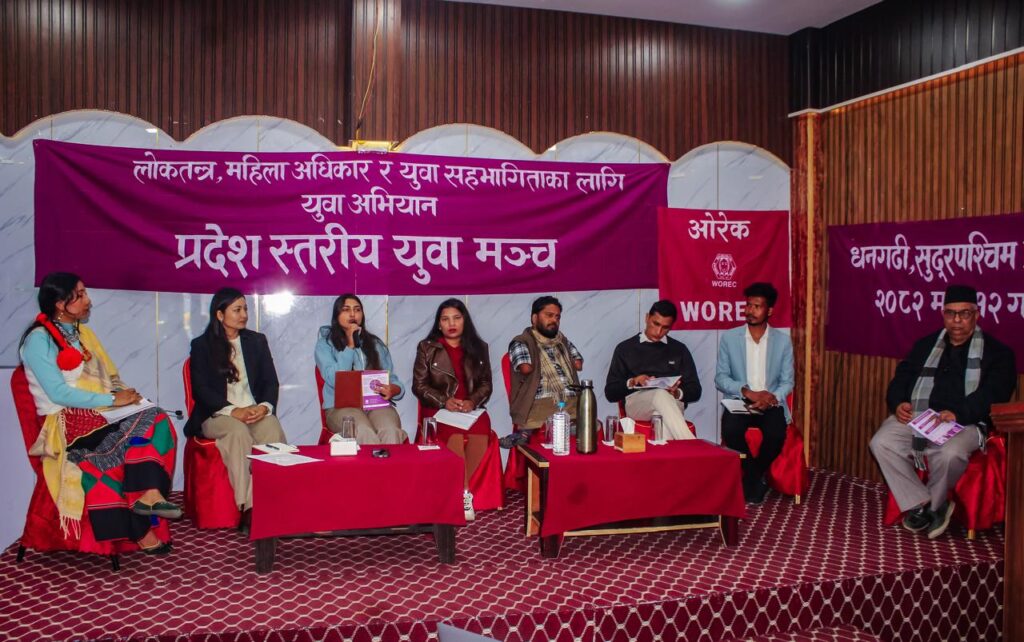
The event was organized on 26 January 2026 with the participation of more than 100 youths of diversity. Youth are hopeful about the upcoming election. While their issues vary, they share a common demand for good governance. Youth expressed interest in political engagement but rejected lifelong career politics, calling for open and accessible political spaces.
“We want to practice politics as a service, not a profession. Politics should be an open space for youth where they can to enter and exit politics easily.” – Padam Saud, Dadeldhura
Lumbini (Butwal):
The event was organized jointly by WOREC and WOFOWON on 2nd February 2026 with the participation of more than 120 youths of diversity. Youth participants openly discussed political candidates and emphasized the responsible exercise of voting rights. Strong demands were raised to ensure meaningful representation of Dalits, Terai Dalits, and sexual and gender minorities. Participants also highlighted the importance of disability-friendly political structures to ensure inclusive and meaningful access. The diversity of the population calls for diverse leadership. Youth stressed that voters should make rational choices based on candidates’ agendas and commitments, rather than their public image or face value. The event was jointly organized by WOREC and WOFOWON.
Women are not even able to vote as per their choices, their vote is decided by the family head, always a man. –Sunita Harijan, Rupandehi
“We want candidates rooted in communities, who knows the issues with way forward not just visible on Google.” – Muna BK, Dang
“Political parties must recognize the capacity of youth with disabilities and create space for leadership.” – Laxmi Pandey, Gulmi
Madhesh (Janakpur):
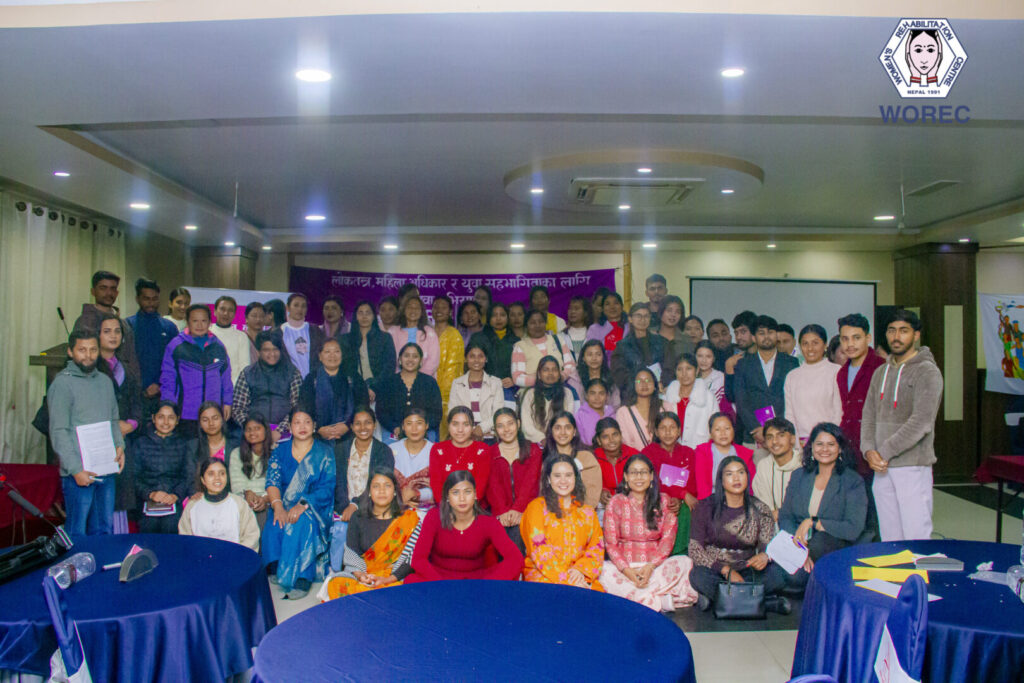
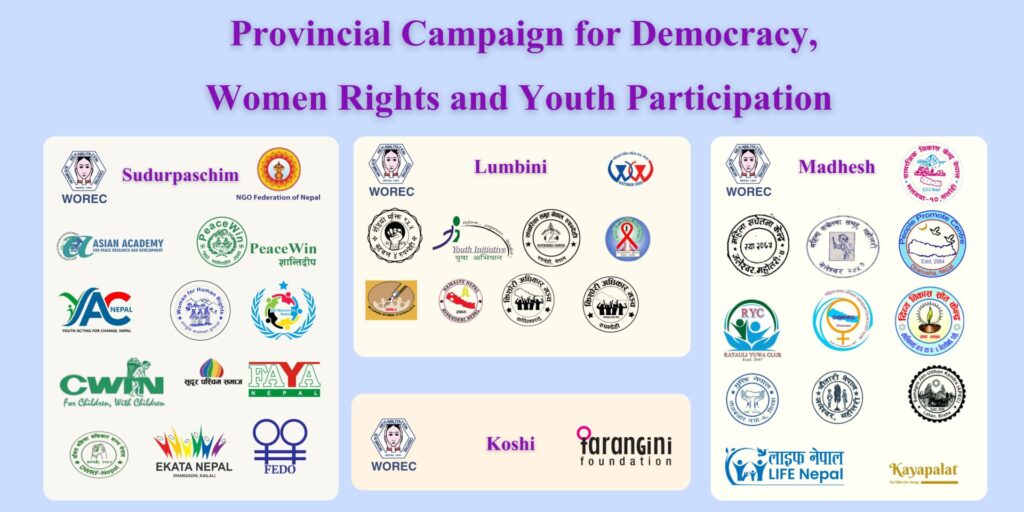
In collaboration with 13 youth/women led organizations and networks, more than hundred youths from all the districts of Madhesh Province came together through the Provincial Youth Forum in Dhanusa. Participants challenged the male-centric definition of “youth” and highlighted the exclusion of women and sexual and gender minorities. The intersecting marginalization of Dalit, Indigenous, Muslim, and trans women was emphasized. Their demands include meaningful participation beyond tokenism, the unconditional right to vote, preservation of constitutional values, youth-friendly and gender-responsive policies, and freedom from all forms of structural discrimination and harmful practices. Participants also raised concerns that Madhesh issues remain underrepresented in policy and demanded youth engagement in modern agriculture.
“Youth want meaningful inclusion—from gender-responsive budgeting to implementation.” – Lalit Mahato, Mahottari
“in my community women need to marry for her citizenship yet, we want that political structure which made women’s right to citizenship easy and accessible to all women from Madhesh province also.” – Atiya Khatun, Janakpur
Key Issues Raised
- Limited youth representation in political leadership.
- Lack of governance and transparency in the political parties along with oligarchy
- Lack of opening political spaces for youth participation without lifelong political entrapment
- Lack of inclusive leadership reflecting the sense of the constitution – diversity from the ground with the state and political party’s structures (Dalits, Terai Dalits, women, sexual & gender minorities, persons with disabilities, Muslim communities, economically challenged community)
- Lack of accountable governance and corruption
- Gender Based Violence, Statelessness, denial of voting rights, knowledge capture and other forms of inequality based on caste, gender, race, identity, religion and disability
- Rising anti-democratic and anti-rights movement, misinformation and disinformation
- Shrinking democratic spaces, impunity and lack of state accountability
Major common demands from the youths:
- Accessible and quality education, expanded technical and vocational training, and decent employment opportunities, including public investment in modern and climate-resilient agriculture, with targeted programs for women, Dalits, Indigenous peoples, and sexual and gender minorities.
- Democratic reform within political parties to ensure transparency, accountability, leadership renewal, and participatory decision-making, and to end elite capture and dynastic control of politics.
- Institutionalization of inclusive leadershipacross state institutions and political parties, guaranteeing proportional representation of Dalits (including Terai Dalits), women, sexual and gender minorities, persons with disabilities, Muslim communities, and economically marginalized groups from local to national levels.
- Meaningful participation of women and youthin all climate-induced disaster risk reduction, preparedness, and response mechanisms at community, provincial, and national levels.
- Political parties to adopt inclusive and democratic structures, ensure meaningful leadership roles for youth and women, institutionalize leadership succession, and provide inclusive political education and training.
- Accountability and zero tolerance for corruption, including transparent governance systems that ensure public resources are used to advance people’s rights, dignity, and equitable development.
- Protection of democratic spaces and state accountabilityby safeguarding freedoms of expression, assembly, and association, ending impunity, and upholding democratic values, human rights, and the rule of law.
Conclusion
Democracy must be lived, not just claimed. It requires dismantling all forms of structural discrimination and ensuring inclusive, meaningful participation—especially for youth, women, and marginalized groups. Gender-based violence, impunity, and tokenism weaken democratic values, making democracy hollow. Youth demand real participation, rights, and accountable political practice, not empty rhetoric. Through feminist and youth-led organizing and active, informed participation in elections, youths commit to strengthening democracy while remaining alert to the dangers of miscommunication and popularity.
Sustainability of the movement
This forum is starting point of a campaign. It will be driven through the ANKUR youth network, an initiative led by WOREC. ANKUR will enable youth to bypass traditional political gatekeepers and create an independent, inclusive space for political engagement.
As a continuous campaign platform, ANKUR will provide youth with a sustained space for dialogue, advocacy, and collective action beyond the conference. The network will be responsible for creating the discourse on youth and maintaining a unified provincial youth front to advance shared political demands and accountability.
The message from the youths is clear: We no longer content to be labeled as “future leaders.” We are current political actors whose intellect, agency and participation are the indispensable requirements for just, stable and democratic future.